Open banking in a nutshell
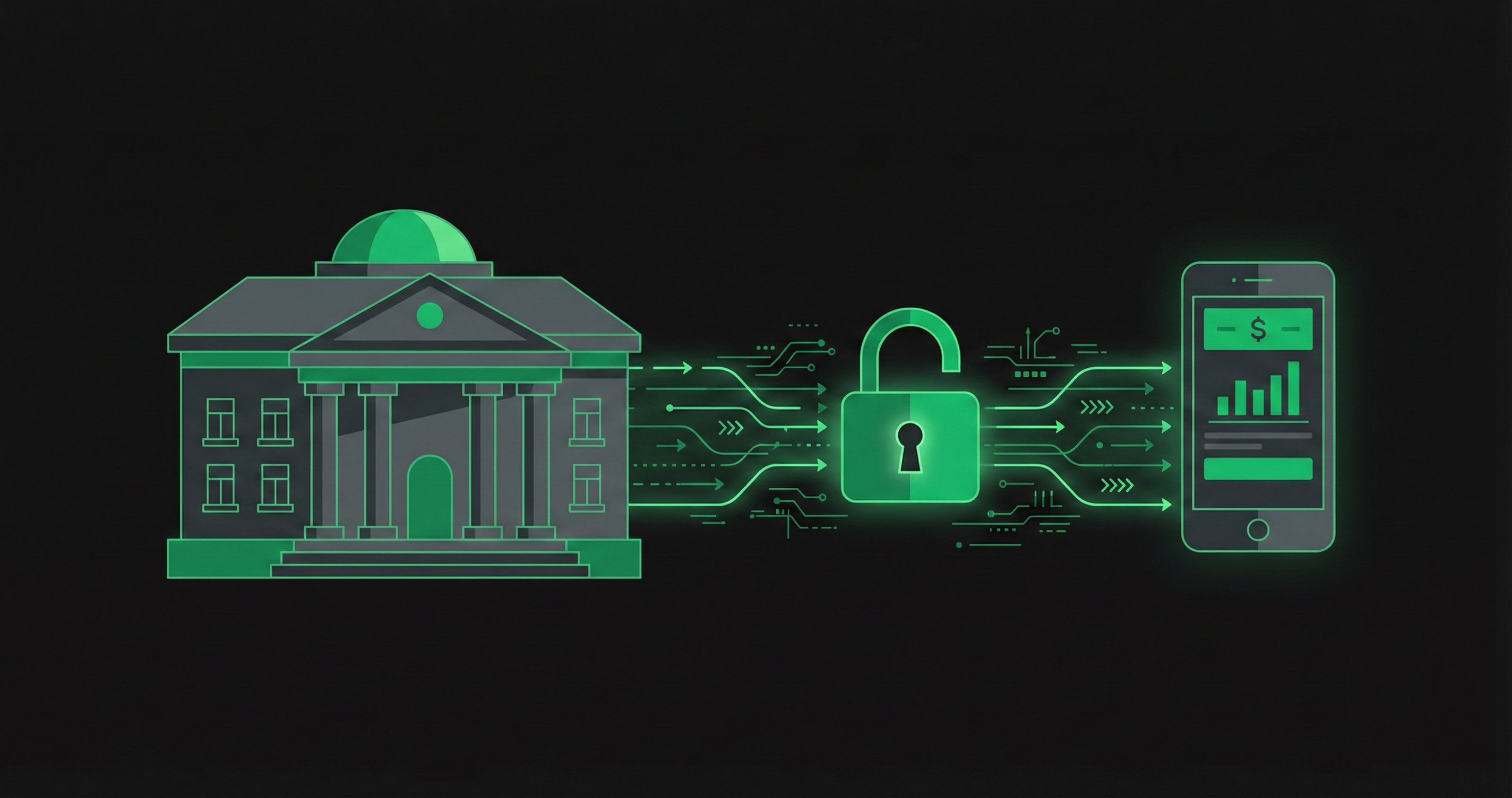
Open banking is a system that allows, with your explicit consent, third-party applications and services to access your banking data. In practice, this means that a budgeting app, a financial comparison tool, or an analytics service can connect directly to your bank account to read your transactions, your balance, or your spending history.
While this concept may seem alarming at first glance, it actually relies on a strict regulatory framework and advanced security mechanisms. And most importantly, it paves the way for innovative financial services that can help you better manage your money — including understanding and reducing the carbon impact of your spending.
The regulatory origin: the PSD2 directive
Open banking in Europe was not born from a banking initiative, but from a regulatory obligation. The Payment Services Directive 2 (PSD2), which came into effect in September 2019, required European banks to open their information systems to authorized third-party providers, via secure programming interfaces called APIs.
Before PSD2, customer banking data was jealously guarded by banks, who used it as a competitive advantage. The directive changed the game by establishing a fundamental principle: banking data belongs to the customers, not to the banks.
"Consumers' payment data belongs to them. PSD2 gives them the power to share it with whomever they wish, in complete security." — European Commission
The actors introduced by PSD2
- AISP (Account Information Service Provider): providers that can read your account data (banking aggregators, budgeting apps)
- PISP (Payment Initiation Service Provider): providers that can initiate payments on your behalf from your accounts
- ASPSP (Account Servicing Payment Service Provider): traditional banks, which must expose their APIs
How does open banking work technically?
The system relies on standardized banking APIs. Here is the concrete process when a third-party application accesses your data:
- You give your consent: you explicitly authorize the application to access your account, specifying which data and for how long
- Strong authentication: your bank requests two-factor authentication (SMS code, fingerprint, mobile app)
- Secure transmission: the bank communicates the requested data via its secure API, without ever sharing your password
- Processing by the application: the application receives the data and analyzes it according to its algorithms
- Revocation possible: you can revoke this access at any time from your banking portal
A crucial point to remember: with regulatory open banking, you never share your banking password with a third party. Authentication is done directly with your bank.
Open banking in France: where do we stand?
France is among the most active European markets in terms of open banking. Players like Budget Insight, Powens, and Tink (acquired by Visa) offer open banking infrastructure used by hundreds of applications. On the consumer fintech side, apps like Bankin', Linxo, and Pennylane rely on open banking to aggregate their users' accounts.
Traditional French banks (BNP Paribas, Societe Generale, Credit Agricole, La Banque Postale) have all developed their PSD2-compliant APIs, although the quality and richness of these interfaces still vary significantly from one institution to another.
Open banking security: what you need to know
What protects your data
- ACPR authorization: in France, any AISP or PISP must be authorized by the Autorite de Controle Prudentiel et de Resolution. Always verify this authorization before using a service.
- Strong Customer Authentication (SCA): every initial connection and every transaction must be validated by multi-factor authentication
- GDPR: your personal data is protected by the General Data Protection Regulation. You have the right to information, access, rectification, and deletion.
- Data encryption: transmissions between banks and providers are encrypted according to banking standards
Residual risks
Despite these protections, a few precautions are in order:
- Verify that the application uses official APIs rather than "scraping" techniques (automated data collection by simulating a human connection)
- Read the terms of use to understand how your data is stored and used for analytical or commercial purposes
- Revoke access granted to applications you no longer use
Open banking use cases
Personal budget management
This is the most widespread application of open banking. Apps like Bankin' or Budgea aggregate all your bank accounts (checking account, savings, loans) into a single dashboard, automatically categorize your spending, and give you a clear view of your budget.
Automatic carbon footprint calculation
This is precisely the use case that Offset explores: by analyzing your bank transactions, it becomes possible to estimate in real time the carbon footprint of your spending. Every supermarket purchase, every fuel fill-up, every online order can be translated into kilograms of CO2. This approach based on actual consumption data is far more accurate than a self-reported questionnaire.
To understand how your banking transactions translate into carbon emissions, read our article: How your bank spending reveals your carbon footprint.
Credit and alternative financial scoring
Open banking allows credit fintechs to assess a borrower's creditworthiness by analyzing their actual cash flows rather than relying solely on declared income. This can facilitate access to credit for atypical profiles (self-employed, freelancers).
Comparison and banking mobility
Comparison services can analyze your spending and suggest banking products better suited to your profile: payment cards with tailored cashback, cheaper insurance, savings accounts with better rates.
Toward PSD3: the future of open banking in Europe
The European Commission proposed in 2023 a new directive, PSD3, which aims to go even further in opening up financial data. Open finance would extend the open banking principle to insurance, savings, investment, and credit data. Negotiations are underway for a phased implementation starting from 2026-2027.
To learn more about the implications of these regulatory developments for your banking data, see: PSD2 and PSD3: how Europe is transforming your banking data.
Conclusion: open banking, an opportunity to seize wisely
Open banking represents a quiet revolution in the financial sector. By putting individuals back in control of their banking data, it creates the conditions for greater competition, more personalized services, and new forms of financial guidance. The key is to use it wisely: verify authorizations, read the terms of use, and revoke unused access.
For consumers who are conscious of their environmental impact, open banking opens a particularly promising path: turning every purchase into a lever for ecological awareness.