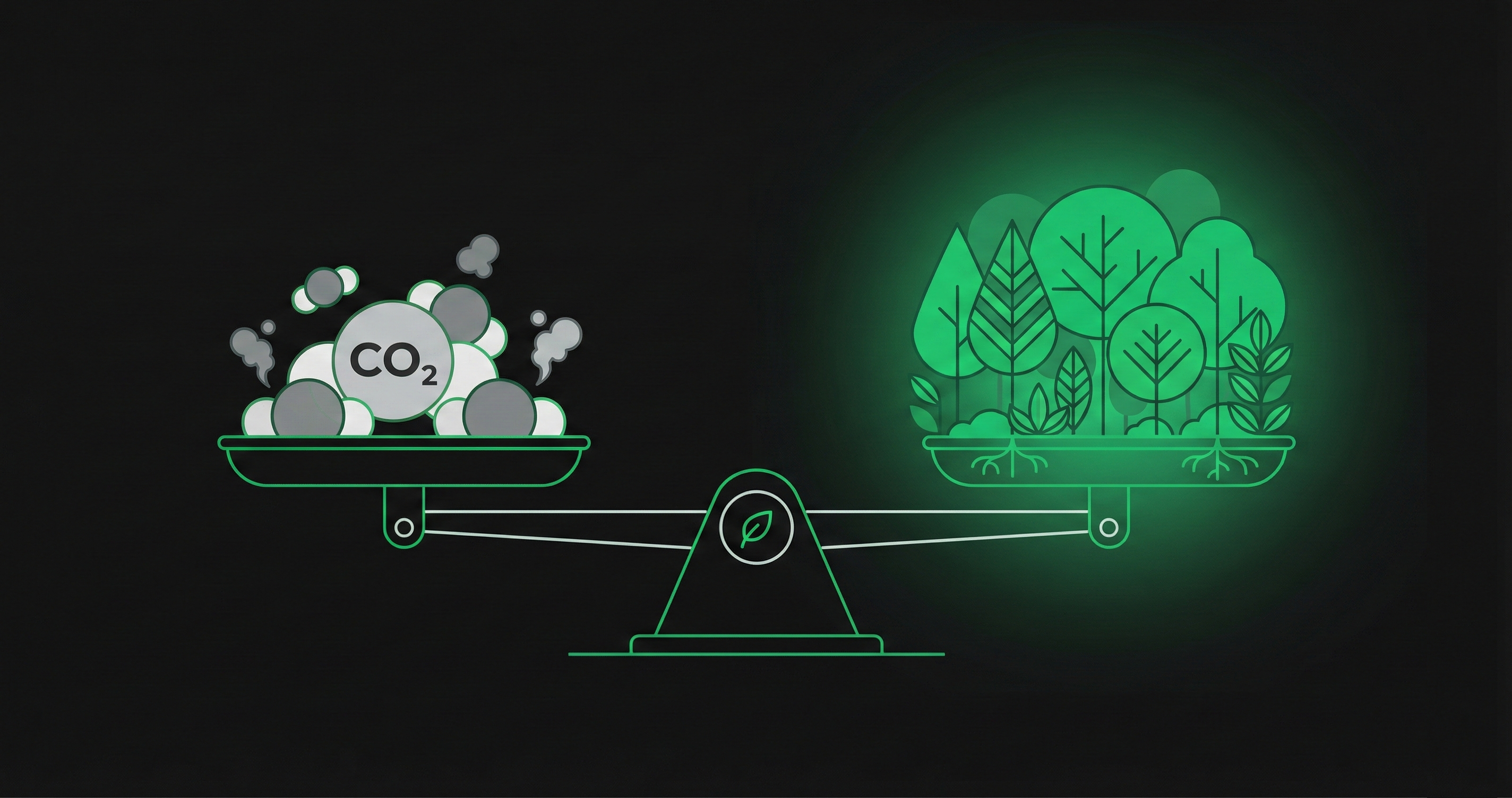
What is carbon offsetting?
Carbon offsetting is a mechanism that allows individuals, companies, or organizations to neutralize greenhouse gas emissions they have not been able to avoid, by funding projects that reduce or sequester an equivalent amount of CO₂ elsewhere in the world. In practical terms, if you emit one tonne of CO₂ on a Paris-New York flight, you can "offset" that emission by paying for one tonne of CO₂ to be avoided or absorbed by a certified project.
It is essential to understand that carbon offsetting is not a silver bullet. It should be seen as a last resort, after every effort has been made to reduce emissions at the source. The order of priority should always be: reduce first, offset second.
How does carbon offsetting work?
The principle is based on a system of carbon credits. Each credit represents the reduction or avoidance of one tonne of CO₂ equivalent. These credits are generated by certified projects and then sold on voluntary markets to buyers who wish to offset their residual emissions.
The lifecycle of a carbon credit
- Project development: a project developer designs an initiative (tree planting, renewable energy installation, methane capture, etc.)
- Certification: the project is audited by an independent body according to recognized standards
- Credit issuance: once validated, the credits are registered in a public registry
- Sale and retirement: the credits are purchased and then "retired" from the market to prevent double counting
Types of offset projects
Projects eligible for carbon offsetting fall into several broad categories:
- Forest projects (REDD+): protection of forests threatened by deforestation, particularly in the Amazon, Indonesia, or the Congo. These projects are among the most widespread but also the most controversial.
- Renewable energy: construction of wind turbines or solar panels in developing countries to replace coal-fired power plants.
- Energy efficiency: distribution of more efficient cookstoves in rural African communities, reducing firewood consumption.
- Methane capture and destruction: recovery of gas from landfills or coal mines.
- Regenerative agriculture: farming practices that sequester carbon in soils.
Recognized labels and certifications
The quality of an offset project largely depends on the label that certifies it. There are several recognized international standards, but their rigor varies significantly.
Gold Standard
Founded in 2003 by WWF and other environmental NGOs, Gold Standard is considered the most demanding label on the voluntary market. It imposes not only strict environmental criteria but also social requirements: projects must demonstrate that they positively contribute to local communities. Each project undergoes regular audits by accredited independent third parties.
"Gold Standard ensures that every tonne of CO₂ offset corresponds to a real, measurable, permanent, and additional emission reduction." — Gold Standard Foundation
Verified Carbon Standard (VCS) / Verra
VCS, managed by the organization Verra, is the most widely used standard in the world in terms of credit volume issued. It applies to a very wide range of projects and requires rigorous calculation methodologies. However, journalistic investigations conducted in 2023 called into question the quality of certain VCS-certified forest projects, pointing to significant overestimates of the tonnes of CO₂ avoided.
Plan Vivo
Specializing in agroforestry projects and rural communities, Plan Vivo is a more modest label but one recognized for its particular attention to local populations and biodiversity.
Label Bas-Carbone (France)
Created by the French Ministry of Ecological Transition, the Label Bas-Carbone is the French reference framework. It certifies agricultural and forestry projects on national territory, allowing French companies to offset their emissions by funding local projects.
Limitations and criticisms of carbon offsetting
Despite its growth, carbon offsetting faces legitimate criticisms that are important to understand before committing.
Additionality: the fundamental principle
A project is considered "additional" if it would not have taken place without carbon offset funding. This is the most difficult criterion to verify. If a protected forest was never actually under threat, the credits generated do not correspond to any real emission reduction.
Permanence of reductions
A forest project can be wiped out by a fire, a disease outbreak, or a change of government. The question of permanence is therefore crucial: one tonne of CO₂ emitted today remains in the atmosphere for hundreds of years, while a planted tree could burn down in five years.
The risk of a "license to pollute"
The most fundamental criticism is behavioral: carbon offsetting risks giving polluters a clear conscience and slowing the transition toward genuine emission reductions. Buying carbon credits should never substitute for a sincere effort to reduce emissions.
Best practices for responsible offsetting
If you wish to use carbon offsetting in an informed way, here are the golden rules to follow:
- Reduce first: apply a strict hierarchy — avoid, reduce, then offset as a last resort
- Demand transparency: ask for supporting documents, audit reports, and GPS coordinates of projects
- Favor recognized labels: Gold Standard or Label Bas-Carbone for national projects
- Choose projects with co-benefits: biodiversity, local development, access to clean water
- Avoid overly cheap projects: a credit sold for less than 10 euros per tonne should raise suspicion
- Verify traceability: the credit must appear in an accessible public registry
What does one tonne of offset CO₂ cost?
Prices on the voluntary market vary considerably: from 5 euros to over 100 euros per tonne of CO₂, depending on the type of project, its certification, and its co-benefits. Forest projects in the Amazon are generally cheaper, while Direct Air Capture projects can exceed 300 euros per tonne.
In France, the price per tonne of CO₂ on the European ETS market has been around 60-80 euros since 2022, providing an indication of the "true" cost of carbon for industries subject to the trading system.
To better understand how carbon markets work and what a carbon credit actually represents, see our dedicated article: What is a carbon credit and how does the market work?
Carbon offsetting and greenwashing: how to tell the difference?
The proliferation of carbon offset offerings has unfortunately fostered the emergence of misleading practices. Companies proudly display their "carbon neutrality" based on poor-quality offsets, without any real effort to reduce their own emissions. This is called greenwashing, and it is crucial to know how to spot it.
To dive deeper into this topic and avoid being misled by marketing claims, read our guide: Greenwashing or genuine offsetting: how to tell the difference?
Conclusion: carbon offsetting, one tool among many
Carbon offsetting is a legitimate and useful tool when used correctly — that is, as the final step of an ambitious climate strategy, not as a way to buy a clear conscience. Quality projects, duly certified and transparent, genuinely contribute to the fight against climate change while delivering valuable co-benefits to local communities.
The key is rigor: demand transparency, thoroughness, and ambition — both from project developers and from yourself. Reducing your emissions always remains the absolute priority.